
 Yoga – or at least classical yoga – is built on ten principles – the five yamas and five niyamas that comprise the first and second stages or “limbs” of Patanjali’s eight limbs of yoga. The ancient Indian sage, Patanjali, believed that we each need to go through these eight stages in order to reach our ultimate destination – enlightenment.
The yamas are generally thought of as social rules of conduct and the niyamas as personal rules of conduct. Over the following weeks I will explore these ten principles of yoga, offering ways we can develop them in our lives.
The five yamas are qualities we are encouraged to develop to change our behaviour and improve our relationships with others. But they are also ways of relating to ourselves and our ways of thinking about others so that our patterns of thought and attitude are positively altered.
The first yama is AHIMSA. It translates roughly as “non-harmfulness”. It is deeply meaningful that “non-harmfulness” or “kindness” is the very basis of yoga. In fact it’s the first of the basics, the very foundation stone of yoga – yoga being a whole way of living. (more…)
 We all know that we can go without food for several weeks; we can go without water for several days, but most of us can’t even go a minute without breathing. So, in a very real sense, breath is life.
 Meditation is central to yoga, as it improves the well-being of your body, mind and life.
 A few days ago I went for a late afternoon walk on the beach with my two dogs. As I reached the car-park at the end of our walk, I was drawn over to the grassy area by the voice of a fitness instructor talking to his class. I was interested to see what he was getting his class to do. I gasped as I heard his say, and then repeat, “one hundred squats!!” Now, they weren’t full squats, nor did the crew keep their backs straight, as in yoga squats, but each person was squatting while holding a weight!
 This is the symbol ‘OM’, and there are many ways of writing OM, just as there are many ways of writing the letters in the English alphabet – just check out the number of fonts available on your computer! The most common way of pronouncing this mantra is OM, but more correctly, it is AUM. It is both a symbol and a mantra (as I spoke about in a
 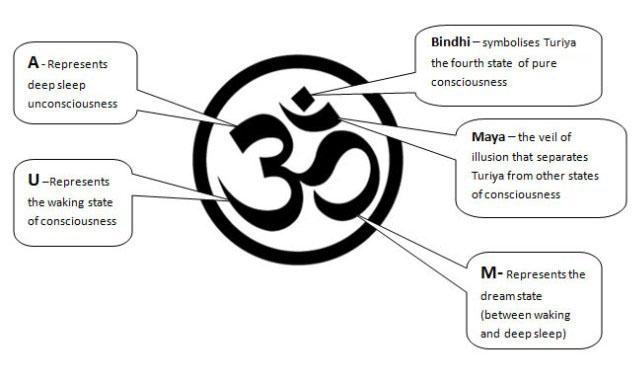 It is made up of A – the waking sound of consciousness
 Om asato maa sad gamaya
 As I write, there’s a little bird whistling, or singing, in a nearby tree. That’s all I can hear. At night I can often hear the rush of the waves onto the beach – the contrast of the quiet night with the music of the waves. Many years ago, Simon and Garfunkel sang “The Sounds of Silence”, and they were right – it is the silence that makes the sound audible. In music, it’s the silence between the notes that makes the tune.
 Life
Life